

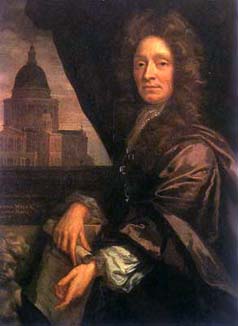
During my ‘book travels,’ ‘I ‘met’ Christopher Wren. (My Oxford professor, Peter McCullough, had much to do with it)
The fascinating Sir Christopher Wren (1632 -1723) was an English architect, astronomer, mathematician and physicist who is one of the most highly acclaimed architects in British history. He was accorded responsibility for rebuilding 52 churches in the City of London after the Great Fire in 1666, including his masterpiece, St. Paul’s Cathedral, completed in 1710.
Educated in Latin and Aristotelian physics at the University of Oxford, Wren was a founder of the Royal Society, and served as its president from 1680 to 1682.
Wren was born in Wiltshire, the only surviving son of Christopher Wren the Elder (1589 – 1658). Christopher Sr. was the rector of East Knoyle. It was there that all their children were born; Mary, Catherine and Susan were all born by 1628. Christopher was born in 1632. Two years later, a daughter, Elizabeth, was born but Mary died shortly after. Through Mary Cox, however, the family became well off financially; as the only heir, she had inherited her father’s estate. Wren was first taught at home by a private tutor and his father after his father’s royal appointment as Dean of Windsor in 1635, but little is known about Wren’s life at Windsor.
Some of Wren’s preserved exercises show that he received a thorough grounding in Latin and also learned to draw. He was also “initiated” in the principles of mathematics. His drawing provided many of the anatomical drawings for the anatomy textbook of the brain, Cerebri Anatome (1664), who coined the term “neurology.” Wren became interested in the design and construction of mechanical instruments. In 1650, Wren entered Wadham College, Oxford, where he studied Latin and the works of Aristotle. Wren also studied science and mathematics at Oxford. He graduated B.A. in 1651 and two years later received M.A. after which Wren was elected a fellow of All Souls’ College and began an active period of research and experimentation. When a fellow of All Souls, Wren constructed a transparent beehive for scientific observation; he began observing the Moon, which was to lead to the invention of micrometers for the telescope. He contrived an artificial Eye, representing the Picture as Nature makes it: The Cornea, and Crystalline were Glass, the other Humors, Water. — Parentalia 209
His days as a fellow of All Souls ended in 1657, when Wren was appointed Professor of Astronomy at Gresham College, London. He was required to give weekly lectures in both Latin and English. He continued to meet the men with whom he had frequent discussions in Oxford. They attended his London lectures and in 1660 initiated weekly meetings. It was from these meetings that the Royal Society was developed. His great breadth of expertise in so many different subjects helped in the exchange of ideas between the various scientists. In addition to being a founder member of the Society, Wren was president of the Royal Society from 1680 to 1682. The main sources for Wren’s scientific achievements are in its records. His scientific works ranged from astronomy, optics, the problem of finding longitude at sea, cosmology, mechanics, microscopy, surveying, medicine and meteorology. He observed, measured, dissected, built models and employed, invented and improved a variety of instruments. Wren continued with his work with the Royal Society, although after the 1680s his scientific interests seem to have waned: no doubt his architectural and official duties absorbed more time.

Christopher Wren sculpted by Edward Pierce 1672
In 1661, Wren was elected Professor of Astronomy at Oxford, and in 1669 he was appointed Surveyor of Works to Charles II. From 1661 until 1668, Wren’s life was based in Oxford; his attendance at Royal Society meetings meant that he made periodic trips to London.
Charles II sought Wren for consult regarding repairs to Old St. Paul’s Cathedral, the reconstruction of which would ultimately be the architect’s ‘magnum opus.’
Wren left for Paris in 1665 on his first and only trip abroad. In France, he met Gian Lorenzo Bernini, who was “widely acknowledged by contemporaries as the greatest artist of the century.” Returning from Paris, Wren made his first design for St Paul’s. A week later, however, the Great Fire destroyed two-thirds of the city. Wren submitted his plans for rebuilding the city to King Charles II. Wren had a presence in the process of rebuilding the city but was not directly involved with the rebuilding of houses or companies’ halls. Instead, Wren was personally responsible for the rebuilding of 51 churches; however, it is not necessarily true to say that each of them represented his own fully developed design. Wren was knighted in 1673, bestowed on him for services to the Crown and in playing an important part in rebuilding London after the Great Fire. Additionally, he was sufficiently active in public affairs to be returned as Member of Parliament on four occasions.
Wren’s career was well established by 1669, In 1669, the 37-year-old Wren married his childhood neighbor, 33-year-old Faith Coghill, daughter of Sir John Coghill of Bletchingdon. This brief marriage produced two children: Gilbert, born in 1672, who suffered from convulsions and died at about 18 months old, and Christopher, born in 1675. who was trained by his father to be an architect. He supervised the topping out ceremony of St Paul’s in 1710.
In 1677, 17 months after the death of his first wife, Wren remarried, this time to Jane Fitzwilliam, daughter of the 2nd Baron FitzWilliam. As with the first marriage, this too produced two children: a daughter Jane, in 1677, and a son William, “Poor Billy” born in 1679, who was reportedly handicapped in some way and never married. Like the first, this second marriage was also brief. Jane Wren is believed to have died of tuberculosis. Though he lived to be over 90 years old, Wren was never to marry again.
In 1696 Wren was appointed Surveyor of Greenwich Naval Hospital, and in 1698 he was appointed Surveyor of Westminster Abbey. Christopher Wren appeared on the reverse of the first British £50 banknote issued in modern times. (It was in circulation until 1996.)
In 1713, he bought the manor of Wroxall, in Warwickshire. According to a 19th-century legend, Wren would often go to London to pay unofficial visits to St Paul’s. On one of these trips, at the age of ninety, he caught a cold and died in his sleep. Wren was laid to rest in March, 1723. His body was placed in the southeast corner of the crypt of St Paul’s. There is a memorial to him in the crypt. The plain stone plaque was written by Wren’s eldest son and heir, Christopher Wren the Younger. It reads:
SUBTUS CONDITUR HUIUS ECCLESIÆ ET VRBIS CONDITOR CHRISTOPHORUS
WREN, QUI VIXIT ANNOS ULTRA NONAGINTA, NON SIBI SED BONO PUBLICO.
LECTOR SI MONUMENTUM REQUIRIS CIRCUMSPICE Obijt XXV Feb: An°:
MDCCXXIII Æt: XCI.
Here in its foundations lies the architect of this church and city,
Christopher Wren, who lived beyond ninety years, not for his own profit
but for the public good. Reader, if you seek his monument – look around
you. Died 25 Feb. 1723, age 91.
Robert Hooke, scientist and architect, said of him: “Since the time of Archimedes there scarce ever met in one man in so great perfection such a mechanical hand and so philosophical mind.”
St. Paul’s Cathedral in London has always been the highlight of Wren’s reputation. The cathedral that Wren started to build bears only a slight resemblance his first blueprint. His association with it spans his whole architectural career, including the 36 years between the start of the new building and the declaration by parliament of its completion in 1711. (In 1697, the first service was held in the cathedral when Wren was 65.) There was still, however, no dome. Finally, in 1711, the cathedral was declared complete, and Wren was paid the half of his salary that had been withheld for 14 years.


c 1490
High Street
*See my book, Rain Dodging to read about my visit to the Banqueting House.
–Wren, Christopher; Ames, Joseph; Wren, Stephen (1750). Parentalia or Memoirs of the Family of the Wrens.
–https://en.wikipedia.org/wiki/Christopher_Wren
–Sir Christopher Wren. English architect. Encyclopedia Britannica. Retrieved 31 August 2018
.


