


Consuelo Vanderbilt Balsan (1877 – 1964) was an American socialite and member of the Vanderbilt family, great-granddaughter of railroad tycoon Cornelius Vanderbilt. She was one of the wealthiest and best-known “dollar princesses” of the late 19th and early 20th centuries, and the financial settlement at the center of her union with the 9th Duke of Marlborough continues to attract commentary and reference more than a century after the wedding took place.
Consuelo’s father, William K Vanderbilt, was a New York railroad millionaire. Her mother, Alva Erskine Smith, the daughter of a cotton broker, was a Southern belle and budding suffragist.
Consuelo’s first marriage to the 9th Duke of Marlborough has become a well-known example of the advantageous but loveless marriages common during the Gilded Age.1 The Duke obtained a large dowry through the marriage and reportedly told her on their honeymoon that he had married her only “because he felt obliged to save Blenheim,” his ancestral home.


For much of their 25-year marriage, the Marlborough’s lived separately. After an official separation in 1906, the couple was divorced in 1921, followed by an annulment in 1926.

Consuelo was dominated by her mother, who had been determined that her daughter would make a grand match. In her 1953 autobiography, The Glitter and the Gold,2 Consuelo described how she was required to wear a steel rod, which ran down her spine and fastened around her waist and over her shoulders, to improve her posture. She was educated entirely at home by governesses and tutors and learned foreign languages at an early age. Her mother whipped her with a riding crop for minor infractions.
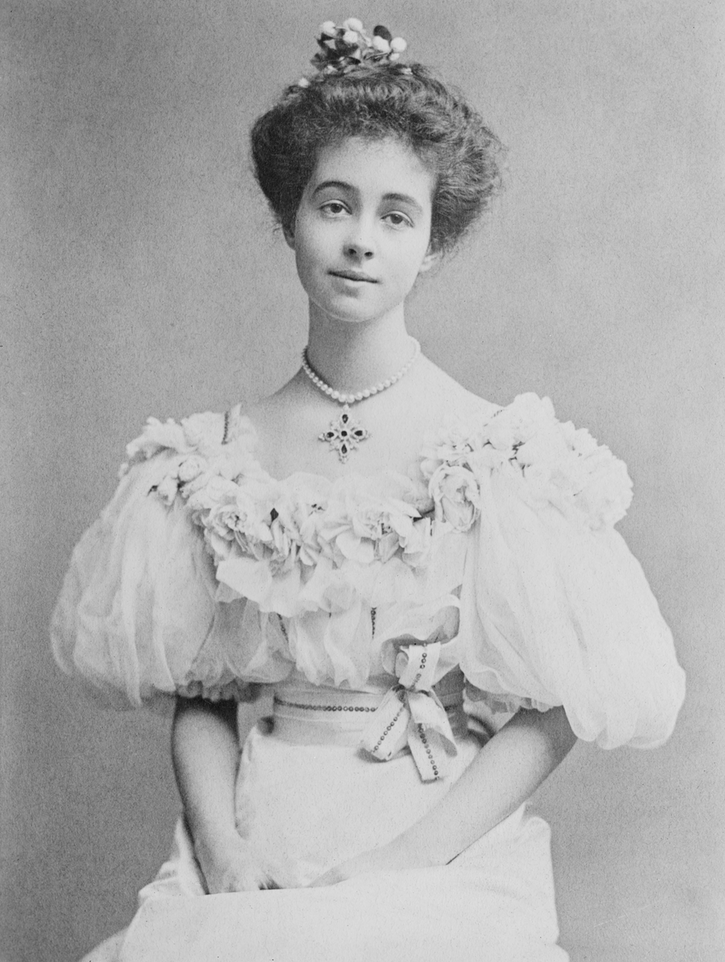
(c. 1890s)
Consuelo Vanderbilt was considered a great beauty, with a “pleasant oval face perched upon a long slender neck, enormous dark eyes fringed with curling lashes, dimples, and a lovely smile.” She embodied the look that was in vogue during the Edwardian Era, 1901 to 1910.
Consuelo had no interest in the Duke of Marlborough, being secretly engaged to Winthrop Rutherford, an American socialite 15 years her senior, but her mother ordered her daughter to marry. When Consuelo made plans to elope, she was locked in her room. Meanwhile, the duke gave up the woman he loved back in England. The wedding took place; Consuelo stood at the altar weeping behind her veil. The duke collected $2,500,000–$91,600,000 in 2025 dollars — in railroad stock as a marriage settlement. They married in Manhattan in 1895 and had two sons. She wrote in her autobiography, “I can do this, I told myself. Somehow, I will survive and thrive.”2
Watch Julie Montague American Aristocrat . A good look into Consuelo’s life in Blenheim Palace.
https://www.youtube.com/watch?v=4Oe9_i-TuEg
The new Duchess was adored by the poor and less fortunate tenants on her husband’s estate, whom she visited and to whom she provided assistance. She later became involved with other philanthropic projects and was particularly interested in those that affected mothers and children. Given the ill-fitting match between the Duke and Duchess, it was only a matter of time before their marriage was in name only. A few years into their marriage, Consuelo reconnected with Winthrop Rutherfurd and went on to spend two weeks in Paris with him. Soon after, she confessed to her husband that she loved Rutherfurd and wished to elope with him. By this time the Duke and Duchess had completely stopped being intimate. The Marlborough’s separated in 1906 and divorced in 1921. The marriage was annulled, at the Duke’s request. During the period between her marriage to the Duke in 1895 and their divorce in 1921, Consuelo, her first husband, and their two sons benefitted from circa $20,000,000 in gifts and inheritances from her father.

Consuelo’s second wedding, on 4 July 1921, was to Lt. Col. Jacques Balsan, a record-breaking pioneer French balloon, aircraft, and hydroplane pilot who once worked with thenWright Brothers. As Consuelo Vanderbilt-Balsan, she published her insightful autobiography, Their marriage lasted until Balsan’s death in 1956 at the age of 88. After his death, Consuelo divided her time between New York and England.
Consuelo was considered to be politically liberal and quite progressive for an aristocrat, with her advocacy for social reforms, such as free school meals, free medical inspection for children, national insurance for workers and old-age pensions. She was also an advocate for women’s suffrage, as her mother had been. During World War I, Consuelo worked as the chair of the Economic Relief Committee for the American Women’s War Relief Fund.
1 “How American Dollar Princesses Changed British Nobility.” Ancestry.com.
25 January 2016. Retrieved 16 October 2022.
2 Vanderbilt Balsan, Consuelo. The Glitter and the Gold: The American Duchess-In Her Own Words. London: Hodder & Stoughton. 1953.


