


When Sara Galner first joined the Saturday Evening Girls Club, she had no idea she’d end up making pottery that sold for thousands of dollars to the rich and famous.
Sara was a poor Jewish immigrant, born in 1894 in Austria-Hungary. Her family lived in Boston’s North End, then a filthy tenement slum with high rates of mortality and murder. Fathers were street peddlers, tailors, shopkeepers, and laborers; mothers worked in local sewing or dressmaking factories or at home. Few girls were encouraged by family members or the community to get an education.


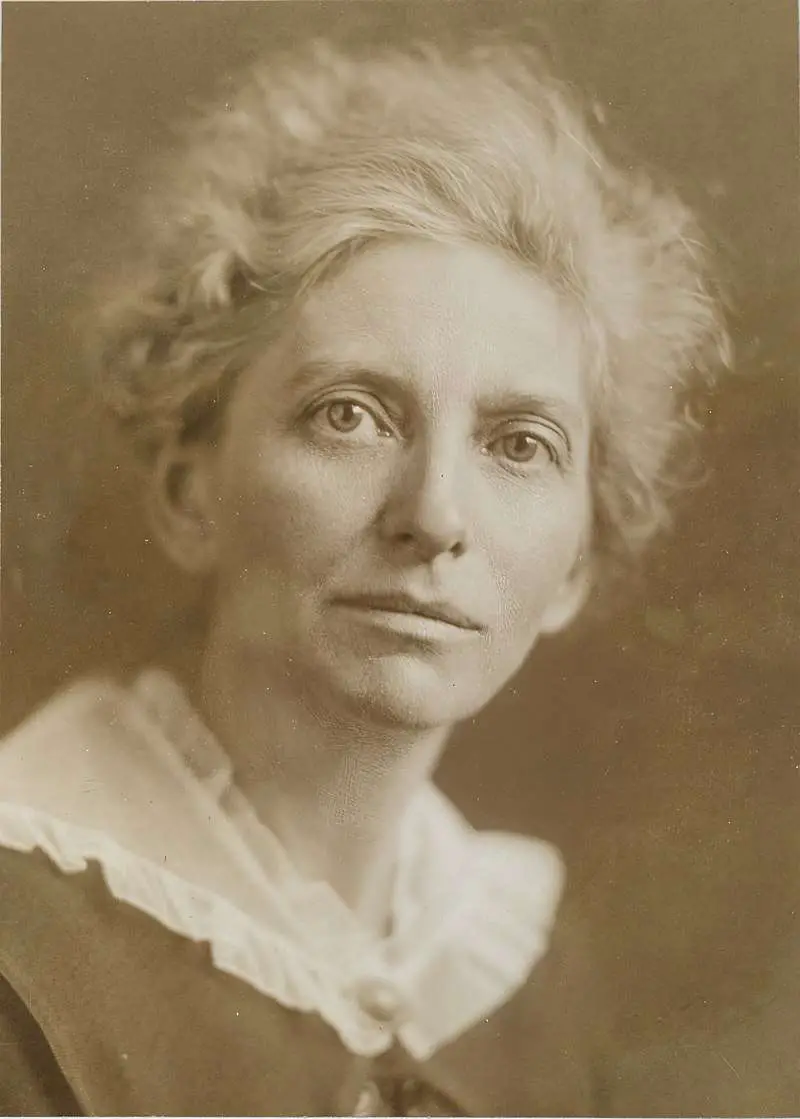
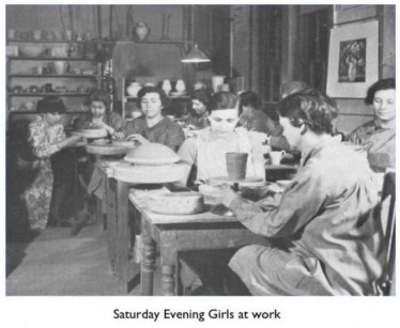
The Saturday Evening Girls started in the 1890s with two women who wanted to better the lives of young immigrant women by involving them in the arts. Helen Storrow, a wealthy Boston philanthropist, supported the North Bennet Steet Industrial School. Storrow also befriended Edith Guerrier, a librarian and writer who started the Saturday evening story hour, exposing immigrant girls to literature, drama and dance.

As a young girl, Sara Galner began attending the book club on Saturday evenings, its members calling it the Saturday Evening Girls Club. Thus, she found herself at the intersection of the Arts and Crafts movement and social reform.
Shortly after the turn of the century, Guerrier and her partner artist Edith Brown travelled to Europe. In Britain, they came into contact with the Arts and Crafts movement, advocating traditional craftsmanship and simple forms. Guerrier and Brown came up with the idea of teaching pottery to the girls so they could make money in a clean and safe environment. Helen Storrow agreed to fund the pottery – a foothold for the Arts and Crafts movement in the United States. She bought a large townhouse on Hull Street and put a pottery and kiln in the basement. She named it after the North End’s most prominent resident, Paul Revere. Light-filled rooms had fresh flowers and light, and the girls listened to music and dramatic readings as they worked. The Saturday Evening Girls also worked an 8-hour day, instead of the usual 12, had half Saturdays off and paid vacations.

Galner was offered a job making pottery for $4/week. She turned it down at first because she made more as a dressmaker. Galner then negotiated a deal where she and the other girls earned $7 a week. Eventually Galner, the most talented ceramic artist, got a raise to $10 a week. The Paul Revere Pottery lasted until 1942.
Today, Paul Revere Pottery is among the most collectible Arts and Crafts style ceramics.
Paul Revere Pottery vase: Saturday Evening Girls
https://commons.wikimedia.org/w/index.php?curid=87862873.
Galner pitcher: Wikipedia Loves Art participant "artifacts"
https://commons.wikimedia.org/w/index.php?curid=8895100.
Edmund Hartt tile: Paul Revere Pottery https://commons.wikimedia.org/w/index.php?curid=87862973.


Thanks for the fun bit of history!